
Game Plan: Episode 5: “P Is For Purpose” — Finding What Truly Drives You With Dr. Rick Wells
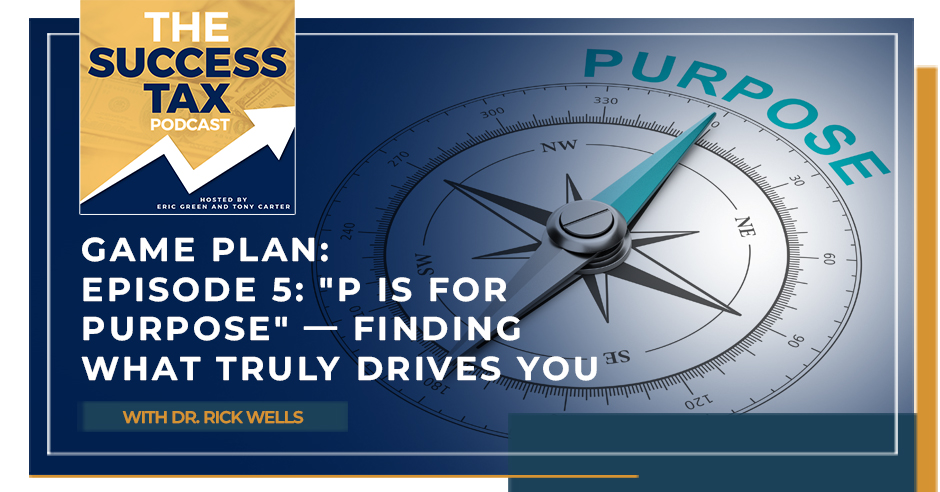
What if your purpose isn’t something you choose—but something that’s been waiting for you to uncover it? In this thought-provoking episode of the Success Tax Podcast, Eric Green and Tony Carter welcome back Dr. Rick Wells to explore the fifth pillar of the G.A.M.E. P.L.A.N. framework: Purpose.
Forget the overused “find your why” advice. Dr. Wells breaks it down deeper—because purpose isn’t just a reason, it’s a calling. Whether you’re a tax pro, entrepreneur, veteran, or public servant, understanding your purpose is about discovering the verb behind what you do—not just the title you carry.
Tune in as the trio dives into:
• Why purpose is something you uncover, not choose
• How identity and service intertwine
• The danger of tying your purpose too tightly to a uniform or job title
• Why purpose fuels fulfillment long after the paycheck or promotion
• Real stories from law enforcement, military, legal, and financial careers that illustrate how purpose evolves
If you’ve ever felt stuck, burnt out, or unsure of your next move, this episode will reignite your drive and offer a path toward deeper meaning in your work and life.
🎧 Listen now and reflect: What is it that you truly do—and who are you becoming as a result?
—
Watch the Episode here
Listen to the Podcast here
Game Plan: Episode 5: “P Is For Purpose” — Finding What Truly Drives You With Dr. Rick Wells
Thanks for joining us back here at the show. I’m Eric Green. I’m joined by Tony Carter, my co-host. We are continuing our adventure through GAME PLAN with Dr. Rick Wells. Dr. Wells is back. What we’re going to be covering is the letter P, which stands for Purpose. We’re having an interesting conversation, as you were getting our coffee.
Someone should.
You are saying you are about finding your why. Thank you, Simon Sinek. It’s a famous Ted talk, and Rick was explaining why it’s much bigger than that. At some point, we had to stop if we want to record this doing everything ourselves. Dr. Wells, thank you for, of course, being back. Let’s get into understanding or finding your purpose. As you’re saying, it’s bigger than why.
Purpose Is An Enduring, Uncovered Meaning
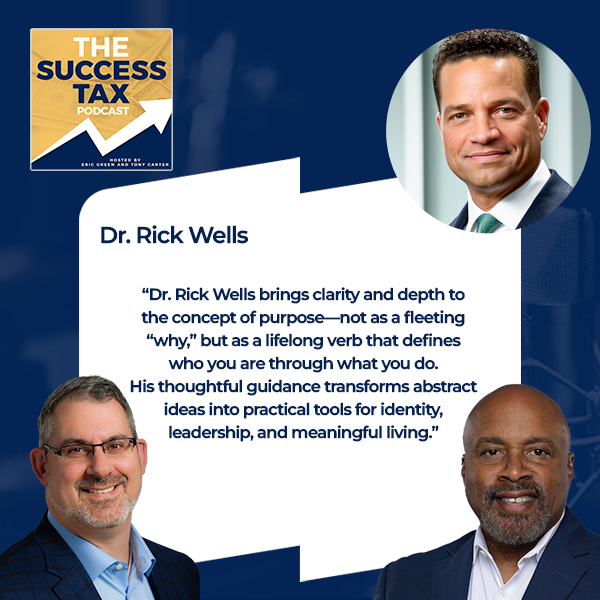
It is bigger than why not to geek out on it too much, but why is an adverb. It’s very difficult to find. We find nouns. The purpose is your enduring meaning behind your life. Whereas wise and when you start to look at it that way, it’s more time-bound. Whereas your purpose is more enduring over a lifetime. It’s something that needs to be uncovered because it’s a function of becoming. You are something. You became something, an officer, an attorney. You did that. We can uncover the purpose behind that. Making that conscious and communicable is the foundation of leadership, the foundation of soul-oriented work, and I think it involves the meaning of one’s life, which I think many people are searching for.
Our show’s about entrepreneurship, and someone wants to go out and become an electrician, a plumber, an attorney, whatever. They’re not setting out to find their purpose, per se, right from the beginning, or are they?
Discovering Purpose Through Action & Self-Reflection
I think it would be a mistake to try and find your purpose and then move. It’s more of a learn by doing. We talked about calling. Talked to G, A, M, and E. Let me find out what game you’re playing. Now the planning that’s starting. The P, it’s the MO for the whole thing. I think a hack for it, if you will, is to answer the question, “What is it that you do as a police officer, as an attorney, as a Marine? What is it that you do?” When I typically ask people, the response is typically a noun. What do you do?
I’m an attorney.
I asked you, what is it that you do? I’m looking for a verb. In order to bring it down to its essence, I’ll give you one verb. What is it that you do? I’ve had many answers to that question. I love, I educate, I develop. That’s the start of it. Your purpose is a function of your response to the world. It’s a function of responsibility. Your actions brought down into that verb, into what is it that you do, is a powerful response to that question.
In other words, I’m not just an attorney. I am someone who helps people solve their financial problems. You’re someone who helps people plan their financial life to accomplish whatever those goals are, versus I’m a financial advisor. I’m an attorney or I’m a police officer. I serve and protect the community. The social contract and all that. How important is it for people, like you said, you don’t necessarily sit, think that through first, and then move. You’re going to move, and you’ll find it through that.
I like that approach very much. Now, one of your passions is working with young families as a financial advisor. Helping them map out their future and relaying the importance of that planning process. How does GAME PLAN fit into that, specifically the P?
Purpose Involves Service & Alignment With Core Values
Let me address what Eric said initially when he mentioned the words of service and help. When you’re engaged with your purpose, you’re automatically, magically involved in that thing which is greater than yourself. You’re focused on the service as an attorney. You’re focused on your contribution as a law enforcement officer. You’re focused on betterment as an educator. That is much larger than yourself. Engaging in that your feet are firmly on the ground while your head can stay in the clouds.
The purpose is your enduring meaning behind your life. Share on XThat magical, I keep saying that because it really is, it becomes a part of who you are. Now, you couple that with what you mentioned in the planning phase. In life, what do you want for your children? What do you want for your lifestyle? What do you want for your legacy? What would you like to be known for? Those things have to be answered and guided by that which you value. That which you value is very interesting. Finding that out is a very interesting exercise because there are espoused values and then there are actual values.
I think you threw me through that exercise.
You can tell me what’s important to you and you can say education, family, and there’s the five, there’s the coaching wheel, your work, your relationships, your health, your spirituality and faith, and your finances. It’s how you spend your time and attention. Your values are a function of your time and what you give your attention to. You can tell me what’s important to you. All I can say is, “Let’s open your checkbook.”
We’ll see.
Purpose Precedes Passions & Performance
We’re going to see how aligned they are. What I’m talking about when you start talking about your mission, again, the purpose precedes your passions and your performance. When we’re talking about the mission and everything, it’s going to be a function of values in that which moves you.
It also comes down to being honest with yourself. There’s a great story about Ben Franklin. Do remember they came out with those Franklin planners, and it was based on, I don’t remember if it was 10 or 12 attributes. Apparently, the story goes that this is based on Ben Franklin writing down the 12 or 10 or whatever number it was that he thought was important.
A friend pointed out, “Modesty is not humble, is not on the list.” Ben Franklin wrote it down. I think a week later saw the friend again with the list, and it was gone. The friend said, “Why did you take it off?” He wasn’t a modest man. He was a showboat in his time. Brilliant guy, but he was honest with himself. “It’s not me. I’m not a modest guy.”
I’m reminded, this is really getting off, Fletch, too. Chevy Chase, at one point he said, “It takes a big man to admit when he’s wrong. I’m not a big man.” Kudos to you. You’re honest with yourself. The Autobiography of Ben Franklin is a short book, and he does go through that exercise, and then he scraps it, but he also mentions in that book the junto, which is the start of the mastermind groups, and the mastermind groups were a small cadre of people.
I think it was no more than 12 or 16, and each of them took a problem or an issue that they were working on, went away, and then came back a month or so later, and then moved the whole group forward. You can see out of that, I don’t know, an actual representation of purposes. It’s not all encompassing. It’s your contribution to this life.
I’m wondering how many people never find their purpose.
I think you could function day to day because there was this idea that you have to survive.
I wonder if those people, and we know them, people who are miserable, they didn’t like what they did, they’re now at the end of their career, and they’re just unhappy. It always struck me that those people never found their actual purpose, because what I find interesting is I wouldn’t tell you that I went into being an attorney to educate and help people.
I went in because it seemed like a decent job, and you could make some money at it and all that. In reality, what I found is that I liked the educating and teaching. My clients are solving their problems, which led into tax rep, which now has led into this. You’re right, I moved first, and it found that as I went through. I’m just wondering how many people never find it.
You seek before you find. You don't find first and then start seeking. Share on XIf I may, because I think for me it’s a function of reflection. An area in my life where I sublimated being an educator was parenting my four children. In parenting them, I reflected on my own experience as a student, as an athlete, as a scholar, as a man of faith. I was like, “This went well for me.” What would I do differently? How can I show up better for my children? Through that questioning, my answer was, “I’m going to raise scholar athletes.”
What that allowed me to do was interact with my children in such a powerful and meaningful way to meand influence them in a total way that I desired. I can tell you, going through that process and parenting my children and seeing them on the other side is why I’m speaking to you right now. I know it’s a pathway for at least me, and it could be a strategy for others, to engage in such an important part of our lives in a meaningful way, where you can look back and say with confidence, with faith that I did the best I could for my children.
I was just thinking about what Eric said about you going into something like being an attorney. In that process that you’re talking about, you realize the things about it that you most loved. I was thinking about the State Police Department, which is my background. It was enough to just get there during those days. I was honored to be there.
I felt that, but I don’t think I had a purpose in the beginning. It was like, “I’m here.” It makes me think about the I am we spoke about. In that particular agency, there is something called The Code of Honor. The first line is, “I am a Connecticut State Trooper, a soldier of the law, to me is entrusted the honor of the department.” I remember reading that for the first time, albeit on my face in a pushup position and in the heat.
In that first line, I think I began to feel like I was finding purpose. There’s power in that. There was meaning in that, in that I am. You go through a whole career with that guidance and with that direction. Eventually, like you, I found the Training Academy, this opportunity to share, coach, lead, and mentor, and it was in those days that I realized my purpose, took some time to get there. It is a journey.
You seek, and then you find. You don’t find, and then you start seeking.
The “I Am” Identity & Purpose As A Contribution to Life
I also suspect it’s why people who go to pursue the money that when they get the money, they’re still empty. We all know people, “I’ll be happy when I have that house. I have that car. I’ve got so much money in the bank.” They get there, and that has no purpose. It just is, and in many ways, it’s I don’t want to say bankrupt, but whatever your issues were, you still have. I don’t know that you’ve fed your soul anything. Listen, finances are one of the five pillars, but it cannot be the only one. Otherwise, you got a one-legged stool, which is the unicycle. You’d better keep pedaling because it’s not going to work out well.
It is powerful, and there are two parts. One is the power of I am. If you understand, it was like, “I am a teacher.” The a teacher part is the identity. That’s what people typically identify with. However, that is a predicate that describes the I am. Your understanding of what I am means, that search for that meaning is what we’re talking about.
It’s the first I am part, which is a very powerful two words. You can uncover that through the narrative that you tell yourself. You expressed how you started being an attorney, but then it became how I can help people. We would tease out that narrative. You talked about how you just needed to get, I would say you answered the call into the police department, and now you realize that there’s something larger, that you’re engaged in something larger than Tony.
They’re like, “What next?” You explore the narratives. I like the stages of life. If you educate and help, great. Give me an example or an anecdote, a narrative of someone who exemplified helping from the ages from 0 to 10. We’ll tease that out. Give me an example of someone who was helpful to you in those high school years from 10 to 18.
Explore that narrative. From 18 to 40, when you’re out there slaying the dragons, who is the vision of helpfulness for that in your life? 40 to 65 and then 65 plus. Give me an example. To take that further, not 65, however, I saw what Andrew Carnegie did for his contribution to society. He’s the one responsible for the public libraries, to put it in context, is that what I would like to be known for?
You start following that trail. It’s an amazing journey. It’s a journey. It’s up the hill. We’re going to keep that going. It’s an uphill challenge. It’s not sliding down the hill. It’s the challenge up the hill. Once you get to do this work, you understand that it may seem like a burden, but when you understand what your purpose is, the burden becomes the point. It’s the thing, Soda.
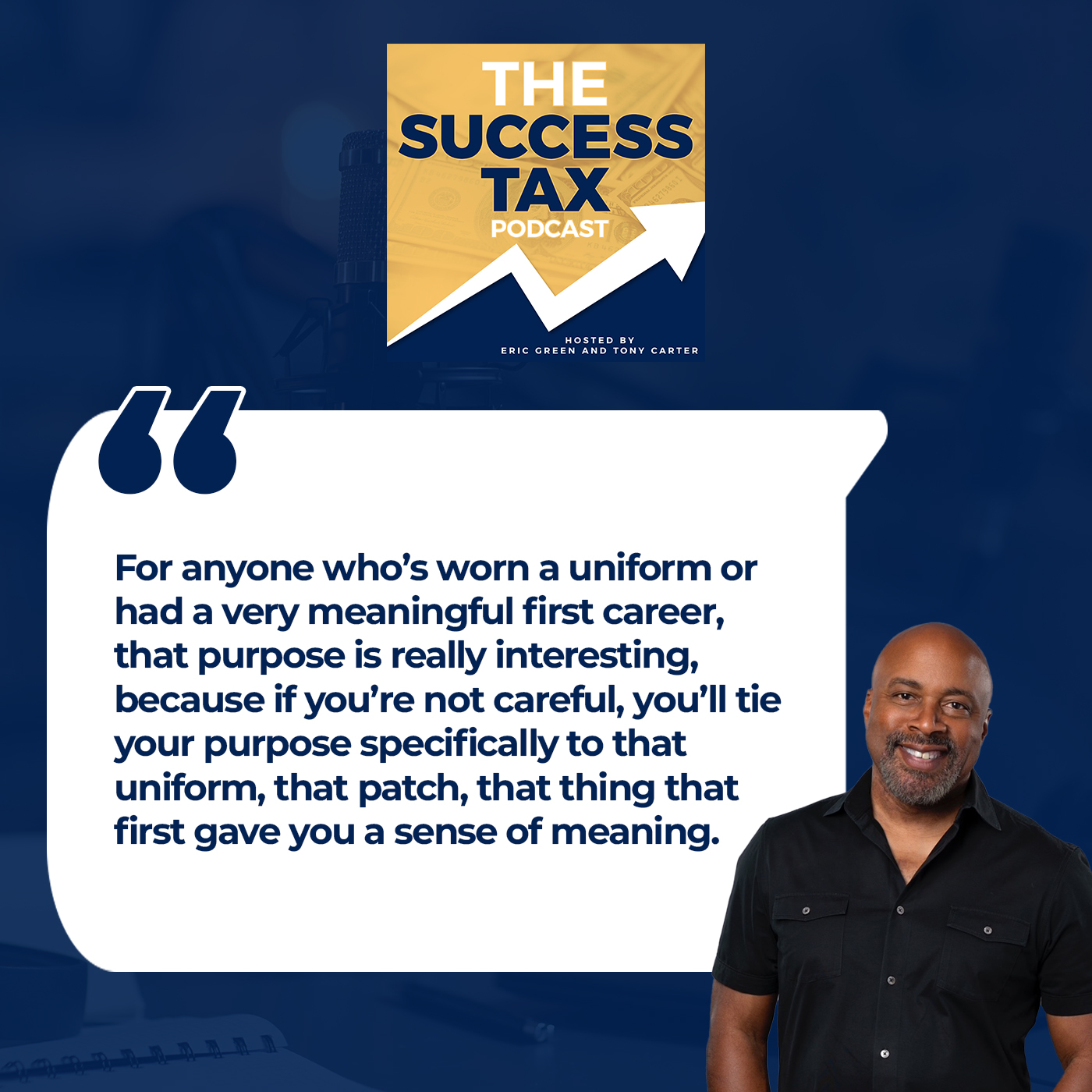
For anybody who’s worn a uniform or who’s had a very meaningful first career, that purpose, that P, is really interesting because if you’re not careful, you’ll tie your purpose specifically to that uniform, that patch, that thing you first gave you a sense of meaning.
It is. That’s a powerful pull and becoming a Marine with all of the tradition and the honor that goes with it. It’s almost a packaged form of purpose. However, I am a Marine. It’s still an identity. I would argue that you’re not that thing. That’s an expression of who you are. For me, it was service to this country and its ideals and its ideas that was the “I found that was the purpose, and I sublimated it through such a powerful organization, institution, and identity of a Marine.” It’s to this day, it’s beneficial.
When you find your purpose, what you choose to do just becomes a sublimation of what it is that you are. Share on XPurpose Fuels Fulfillment Beyond Identity Or Material Wealth
I’m very hopeful that people that are reading, particularly coming from the Marine Corps or other armed forces, police, anything you’re wearing a uniform, because some people feel like they lose their purpose. They lose their drive, their ambition. Some lose that to even live because you feel as though you’ve lost the one thing that gave you purpose, and the way you said it is perfect. That was just the way that you expressed your purpose. That means you can pivot and you can move to something different where you are expressing that and garner that same satisfaction.
When you find that, what you choose to do just becomes a sublimation of what it is that you are. I educate as a Marine. I educate as a teacher. I educate as a financial professional. I educate as a tax attorney. That’s who I am. This is what I do. I’m about that life. It’s not that, it’s that which fuels it.
I think that we’ve pretty well covered it unless you want to add more to that.
No, in fact I’m wondering for the folks, know listening and watching if they’re on YouTube is have you found your purpose? If not sit down and give that some thought. I mean, you are here doing something. Where are you going? What is it that’s driving you, and I also think people might find that, if in fact that’s my purpose, there are other things I can pivot to that might be more fulfilling. It might be more financially rewarding. If I know that, “I’ve realized I want to educate and help people, can I take that into other positions and accomplish potentially even more?”
We’ve covered a few of the letters of GAME PLAN, and you and I talked about this yesterday, and Eric and I talked about it. We’ve got to get to a place where people can find you. Maybe people want to have a conversation with you about this.
Even instead of messaging us.
Is there a place where people can meet you? Is there an email? We’re certainly going to put a link on this fine.
I’ll give you the email and the contact information, the best way to contact me. Demonstrates commitment, find me.
If you’re serious, you’ll find me on your own.
No, we’ll put that in the description. You can go look at the description, you’ll find the best way to contact Dr. Wells. Thank you again, and I think we’re going to move on. The next episode is going to be about Learning.
Absolutely.
Thanks, everyone, for watching. Until the next time.
Important Links
- Dr. Rick Wells on LinkedIn
- Dr. Rick Wells on Instagram
- RWells@baystatefinancial.com
- The Autobiography of Ben Franklin
About Rick Wells
 Rick Wells is a dedicated leader, educator, and advisor with over three decades of service to his community and country. A retired Lieutenant Colonel in the United States Marine Corps Reserve, Dr. Wells spent his military career in both active duty and reserve roles, culminating in his retirement after years of exemplary service.
In addition to his military career, Dr. Wells retired as a highly respected elementary school teacher from the West Hartford Public Schools. Throughout his tenure, he inspired young minds with a commitment to fostering growth, resilience, and achievement. His innovative approach to education emphasized the importance of perseverance, mastery, and the cultivation of self-awareness—skills he believes are foundational to both academic and personal success.
As a financial advisor, Dr. Wells brings his service-oriented ethos to helping families, professionals, and organizations build strong financial futures. His expertise in retirement planning and wealth management reflects his dedication to guiding others through challenges to create sustainable solutions that align with their values and goals.
A staunch advocate of health and wellness, Dr. Wells champions the principles of commitment and consistency as a key to building strength and overcoming challenges. Drawing from his military, educational, and personal wellness journey, he inspires others to embrace challenges as opportunities for mental, physical, and spiritual growth.
Through his work as a mentor, speaker, and advisor, Dr. Wells shares powerful insights on goal setting, leadership, and wellness. With decades of dedicated service to the community and the country, Dr. Wells continues to lead by example, offering practical strategies to elevate individuals and organizations alike.